

Fear of losing your children during divorce reflects the adversarial framing of litigation, not your actual legal risk in Illinois.
Illinois law presumes that both parents remain meaningfully involved in a child’s life after divorce, and collaborative divorce reinforces that by keeping parenting decisions in the parents’ hands rather than a judge’s.
Anna P. Krolikowska, J.D., of Anna K Law, a Northbrook, Illinois family law firm, structures the collaborative process to protect that relationship.
Key Takeaways
- Illinois law presumes both parents remain meaningfully involved in a child’s life after divorce, under the Illinois Marriage and Dissolution of Marriage Act.
- Collaborative divorce includes a neutral child specialist as a standard team member, a feature litigation and basic mediation do not offer.
- A 2020 meta-analysis of 24,854 divorced families found interparental conflict predicts children’s behavioral and emotional problems through impaired parenting quality, not divorce itself.
- Illinois separates parental responsibility into two distinct categories — significant decision-making and parenting time — under 750 ILCS 5/602.7.
Worried a contested divorce could damage your bond with your children? Anna K Law keeps custody decisions in your hands, not in a courtroom — schedule a free 30-minute consultation.
Is It Normal to Fear Losing Custody of Your Children During an Illinois Divorce?
Fear of losing custody is a common reaction to divorce, but Illinois eliminated the “custody” framework under 750 ILCS 5/600 (P.A. 99-90, eff. 1-1-16), replacing it with parental responsibility allocation instead. This change removed the win-or-lose language that fuels much of the fear parents describe.
Instead of one parent “winning custody,” Illinois courts allocate specific responsibilities between both parents based on the child’s best interests.
Parents retain parenting time and a share of decision-making unless the court finds documented abuse, neglect, or substance dependency.
Illinois’s parental responsibility presumption differs sharply from the common misconceptions parents carry into their first consultation, which are addressed further in the common misconceptions about the process.
How Does Collaborative Divorce Address Parents’ Fear of Losing Their Children?
Collaborative divorce addresses this fear directly by adding a neutral, child-focused professional to the collaborative team and removing the adversarial framing that makes litigation feel like a fight for custody.
The Child Specialist’s Role
A child specialist is a licensed mental health professional trained in child development who serves as the child’s voice during the collaborative process.
The child specialist meets with the children separately, then reports developmental needs and concerns to both parents so that decisions are grounded in the children’s actual experiences rather than in each parent’s fears or assumptions.
The Divorce Coach’s Role
A divorce coach manages the emotional and communication dynamics between spouses so fear and reactivity do not drive decision-making.
The divorce coach’s role is distinct from the child specialist’s role, and the coach works with each parent individually, a distinction covered further in Professional Insights Into the Collaborative Divorce Process.
How Is Parental Responsibility Allocated Under Illinois Law?
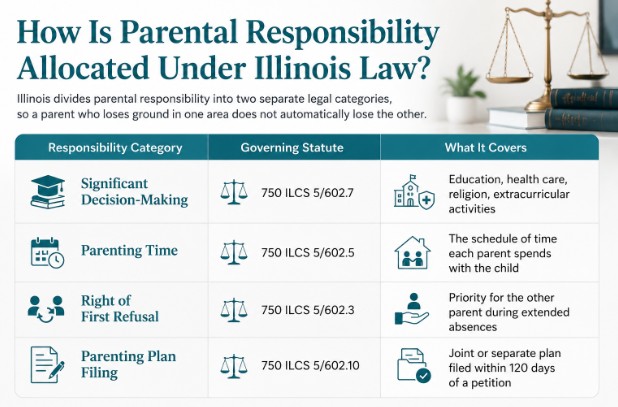
Illinois divides parental responsibility into two separate legal categories, so a parent who loses ground in one area does not automatically lose the other.
| Responsibility Category | Governing Statute | What It Covers |
| Significant Decision-Making | 750 ILCS 5/602.7 | Education, health care, religion, extracurricular activities |
| Parenting Time | 750 ILCS 5/602.5 | The schedule of time each parent spends with the child |
| Right of First Refusal | 750 ILCS 5/602.3 | Priority for the other parent during extended absences |
| Parenting Plan Filing | 750 ILCS 5/602.10 | Joint or separate plan filed within 120 days of a petition |
Courts can allocate significant decision-making jointly, solely, or split by subject area, so a parent does not need unanimous agreement on every issue to remain fully involved.
Illinois’s joint-or-split allocation option is one reason collaborative divorce and mediation let families design more specific parenting time arrangements than a standard court order.
Can Collaborative Divorce Prevent Long-Term Damage to the Co-Parenting Relationship?
Yes — collaborative divorce can reduce long-term co-parenting damage because it directly targets parental conflict, the variable research identifies as the true driver of harm to children, not divorce itself.
A 2016 systematic review by Lamela and Figueiredo found that post-divorce co-parenting quality ranks among the strongest predictors of children’s mental health outcomes after divorce.
A 2020 meta-analysis reviewing 115 samples of 24,854 divorced families similarly found that interparental conflict predicts children’s behavioral and emotional problems through impaired parenting quality — meaning conflict, not divorce itself, drives the harm.
Collaborative divorce targets that variable directly: because both spouses commit to the Collaborative Process Act and work with a coach and a child specialist, the process is designed to model and reinforce the low-conflict communication that those studies identify as protective.
This is a structural difference from litigation, which Child-Centered Divorce Solutions covers in more detail for parents evaluating their options.
Still uncertain whether a peaceful divorce with your spouse is possible? Anna K Law’s collaborative process is built for exactly this concern — book your consultation today.
What Happens If My Spouse Won’t Cooperate in the Collaborative Process?
If either spouse refuses to participate in good faith, the collaborative process can stall or terminate, but Illinois law still protects the non-cooperating spouse’s decision-making and parenting time rights during that transition.
Both collaborative attorneys must withdraw if the process fails, and the family moves to traditional litigation with new counsel.
Illinois attorneys use specific tools to keep collaborative sessions productive before termination becomes necessary, including bringing in a coach or scheduling structured breaks during high-tension meetings — strategies outlined further in collaborative divorce problems.
How Does Collaborative Divorce Compare to Litigation When Children Are Involved?
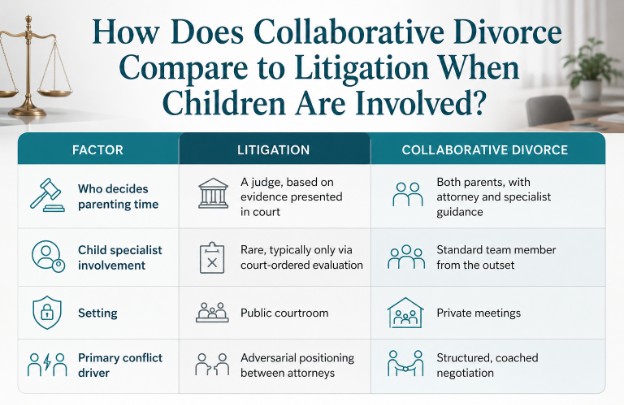
Litigation and collaborative divorce differ most sharply in who controls parenting decisions and how much conflict children are exposed to during the process.
| Factor | Litigation | Collaborative Divorce |
| Who decides parenting time | A judge, based on evidence presented in court | Both parents, with attorney and specialist guidance |
| Child specialist involvement | Rare, typically only via court-ordered evaluation | Standard team member from the outset |
| Setting | Public courtroom | Private meetings |
| Primary conflict driver | Adversarial positioning between attorneys | Structured, coached negotiation |
Parents comparing their full range of Illinois divorce options often find that this difference in who controls parenting decisions — not the paperwork itself — is what ultimately protects the parent-child relationship long after the case closes.
How Do I Know If Collaborative Divorce Is Right for My Family’s Custody Concerns?
Collaborative divorce works best for parents willing to engage in structured negotiation, even if trust is currently low, and who want a child specialist actively involved in shaping the parenting plan.
Collaborative divorce is generally not appropriate in cases involving domestic violence, active substance abuse, or a spouse unwilling to disclose information honestly.
Reviewing the benefits of collaborative divorce and the Illinois collaborative divorce timeline together can help a parent evaluate whether the process fits their specific custody concerns before committing to it.
Ready to protect your relationship with your children through a divorce process built for that goal? Anna K Law offers a free 30-minute consultation to walk through your specific situation.
Frequently Asked Questions
Will I lose custody of my children if I don’t fight for it in court?
No. Illinois no longer uses a single “custody” award. Parental responsibility is allocated across decision-making and parenting time separately under 750 ILCS 5/600, and courts presume both parents remain involved unless the court finds documented abuse, neglect, or substance dependency.
Does collaborative divorce give my spouse more control over our children?
No. Both spouses retain independent attorneys throughout the collaborative process, and the child specialist serves as the voice of the child, representing the children’s developmental needs rather than either parent’s position, keeping negotiations balanced instead of one-sided for either spouse.
What is the difference between decision-making responsibility and parenting time?
Decision-making responsibility covers major choices like education, health care, religion, and extracurricular activities under 750 ILCS 5/602.7. Parenting time covers the physical schedule a child spends with each parent under 750 ILCS 5/602.5. Illinois allocates these two categories separately, rather than as a single custody order.
Can my spouse take our children and refuse to let me see them?
No. Once a parenting plan or temporary order is filed under 750 ILCS 5/602.10, both parents must follow the allocated parenting time schedule. Violating a court-ordered schedule can result in enforcement action, including contempt proceedings against the violating parent in Illinois courts.
Does a child specialist take sides between the parents?
No. A child specialist is a neutral, licensed mental health professional trained in child development whose role is to represent the child’s developmental needs and voice, not to advocate for either parent’s preferred outcome. The specialist meets with children separately during the collaborative process.
What happens to parenting time if the collaborative process fails?
If the process terminates under the Collaborative Process Act, 750 ILCS 90, both collaborative attorneys must withdraw, and the family transitions to litigation with new counsel. Existing temporary parenting arrangements typically continue until an Illinois court issues new orders in the case.
Is collaborative divorce slower than litigation when children are involved?
Not usually. Collaborative divorce often resolves faster than contested litigation because it avoids court backlogs and formal discovery, though the exact timeline depends on how quickly both parents and their child specialist and coach can reach agreement on parenting terms.
Can I request a specific child specialist for my case?
Yes. Parents typically select the child specialist jointly with input from their collaborative attorneys, choosing a licensed mental health professional whose background fits the children’s ages, needs, or developmental concerns identified during the collaborative divorce process in Illinois for their family.
Will my children have to testify or speak to a judge?
Not in a successful collaborative process. The child specialist gathers the children’s perspective privately and reports it to both parents, so children are not placed in a courtroom or asked to choose between parents during an Illinois divorce, unless the process later fails.
Does fear of losing parenting time ever justify choosing litigation instead?
Rarely. Litigation introduces the adversarial, win-or-lose dynamic most parents fear in the first place. Collaborative divorce or mediation typically better protects the parent-child relationship by keeping decisions with the parents instead of a judge, except in cases involving abuse or safety risks.

Anna P. Krolikowska, an attorney in the Northbrook law firm of Anna P. Krolikowska P.C, focuses her practice in the area of family law. Anna realizes that importance and the impact family law matters have not only on her clients, but also on their families. From divorce and child custody to any judgment modifications, Anna considers the unique circumstances of each case to develop a course of action designed specifically to address each client’s unique needs.